
How to restream your webinar to multiple platforms with WebinarGeek

Bryan
12 May 2022 - 5 min - Updated: 09 June 2026
Your audience probably doesn’t live in one place. Some people follow your company on LinkedIn. Others prefer YouTube. Maybe you have a community on Facebook where people are already active. So when you host a webinar, it makes sense to bring the live session to the places where people already spend their time.
That’s where restreaming comes in.
With WebinarGeek, you can restream your webinar directly to external platforms like YouTube, LinkedIn, or Facebook. You host the webinar in WebinarGeek, and at the same time, your live stream can appear on other channels too.
No separate Restream setup. No OBS workaround. No switching between different tools while you’re trying to focus on your webinar.
Just one webinar that can be viewed from multiple platforms.
What is webinar restreaming?
Webinar restreaming means that you broadcast one live webinar to another platform at the same time.
Let’s say you’re hosting a live webinar in WebinarGeek. Your registered attendees join the webinar room, interact with you, answer polls, click your call to action, and receive follow-up emails afterwards.
At the same time, you can also send that live stream to YouTube, LinkedIn, or Facebook.
So instead of choosing between your webinar platform and your social channels, you use both. WebinarGeek remains the place where the full webinar experience happens. Social platforms become extra places where people can discover and watch your content.
That’s useful, because not everyone who might be interested in your webinar will register in advance. Some people only notice your content once it appears in their feed.
Why restream a webinar?
Restreaming is mostly about reach. It helps more people see your live content without asking you to run the same session multiple times.
A registration page works well for people who already know they want to attend. Social platforms help you reach the people who did not sign up yet, but might still be interested when they see you go live.
It also gives your webinar more chances to be noticed. Live content often feels more immediate than a regular post or pre-recorded video. People see that something is happening right now, which makes it easier to grab their attention.
And maybe the biggest benefit: you don’t have to create a separate live session for every channel. You host your webinar once in WebinarGeek and send the stream to other destinations from there.
That keeps things a lot calmer behind the scenes.
Use social platforms for reach, WebinarGeek for the full experience
Going live on social media is useful. But social platforms are not built for the full webinar journey.
They are good at helping people discover your content. They are less good at giving you registration pages, reminder emails, attendee data, polls, calls to action, automated follow-up, and clear webinar analytics.
That’s why it makes sense to keep WebinarGeek as your main webinar environment.
Your registered attendees get the complete experience: they can sign up, receive emails, join the webinar room, interact during the session, and get follow-up afterwards.
Your social audience gets a way to watch from the platform they already use.
So it’s not really “WebinarGeek or social media.” It’s WebinarGeek as the home of your webinar, with social platforms as extra doors into your content.
How to restream your webinar with WebinarGeek
In the past, restreaming a WebinarGeek webinar often meant using an external tool like Restream, together with OBS. That worked, but it also added more setup. Now you can add restream destinations directly inside WebinarGeek.
Click on Edit webinar, open the Webinar step, and look for Restream destinations. From there, you choose the platform you want to stream to, such as YouTube, LinkedIn, or Facebook. Then you add the stream key from that platform.
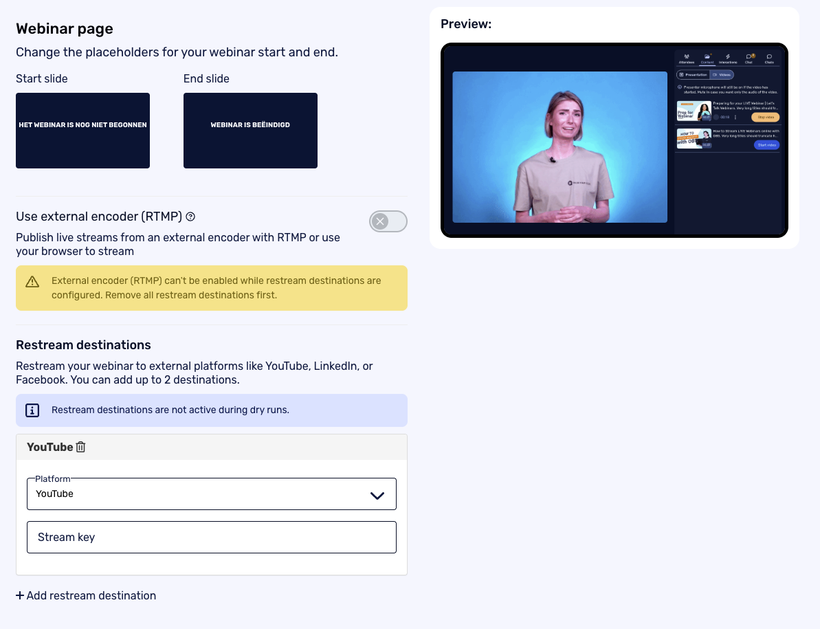
Once the destination is added, WebinarGeek can send your live webinar stream there while your webinar is running.
You can add up to two restream destinations. For example, you could host your webinar in WebinarGeek and stream it to YouTube and LinkedIn at the same time.
That way, you still manage the webinar from one central place. Your registration, emails, interactions, analytics, and follow-up stay in WebinarGeek. Your social channels help extend the reach.
One thing to keep in mind: restream destinations are not active during dry runs. So make sure to check your destination setup before your live webinar starts.
Restreaming vs going live on social media only
You can always go live directly on a social platform. For a quick update or informal broadcast, that might be enough.
But a webinar usually needs more structure. You want people to register. You want to send reminders. You want interaction during the session. You want to know who attended. And you probably want to follow up afterwards.
Social media can help people find your webinar. WebinarGeek helps you turn that attention into a proper attendee journey.
Tips for better webinar restreaming
Restreaming works best when you keep it focused. More platforms do not automatically mean better results.
Choose the channels where your audience is actually active. For many B2B webinars, LinkedIn is a logical choice. For educational content, YouTube can work well because people are already used to watching longer videos there. If you have an engaged group or community on Facebook, that can be a strong option too.
It also helps to promote the webinar before you go live. Share the registration page, but also let people know where they can watch the stream. If the platform allows it, create the live event in advance so people can save it or get notified.
Keep the title clear. People scrolling through a feed don’t have much context, so the topic needs to make sense quickly. A simple title that tells people what they’ll learn is usually better than something clever but vague.
Before the webinar starts, check the basics: the destination, the stream key, the title, the description, and the platform settings. Since restream destinations are not active during dry runs, this is worth doing carefully.
And don’t forget your call to action. Social won't see the same buttons or interactions as people inside WebinarGeek, so tell them clearly what to do next. Register for the full session. Ask a question. Download a resource. Watch the replay. Pick one next step and make it easy.
Webinar formats that work well for restreaming
Some webinars are naturally easier to restream than others.
Live interviews are a good example. They feel conversational, they are easy to promote, and they often work well when your guest has their own audience.
Product launches are another strong fit. You can run the full launch inside WebinarGeek while also streaming the announcement to your social channels for extra visibility.
Expert panels work well too, especially when the topic is relevant to a broader audience. People can tune in, listen to different perspectives, and still get value even if they don’t join from the start.
Educational webinars are also great for restreaming. A practical how-to session or workshop can attract people who are actively looking for help with a specific topic.
And then there are live Q&A sessions. These are simple, flexible, and easy to follow. People can join for a few minutes, listen to the questions, and still walk away with something useful.
Restream your next webinar with WebinarGeek
With WebinarGeek, you can host your webinar once and send the live stream to platforms like YouTube, LinkedIn, or Facebook. You get extra visibility on social media while keeping the full webinar experience in one central place.
Explore hosting webinars today
Start free trialRelated articles
Preventing and managing technical issues during your online event
Hosting online events can be exciting, but let’s face it: technical issues can sneak up on you, and that’s the last thing you want. So how can you prevent and manage those issues? In this blog, we’ll walk you through how to stay calm, focused, and professional while delivering a seamless experience for your audience.
The Ultimate Guide for the Best Tech Equipment to Host Webinars
Are you looking for a way to host professional-looking webinars without having to invest in an expensive webcam? This is how you can use your phone camera as a webcam.
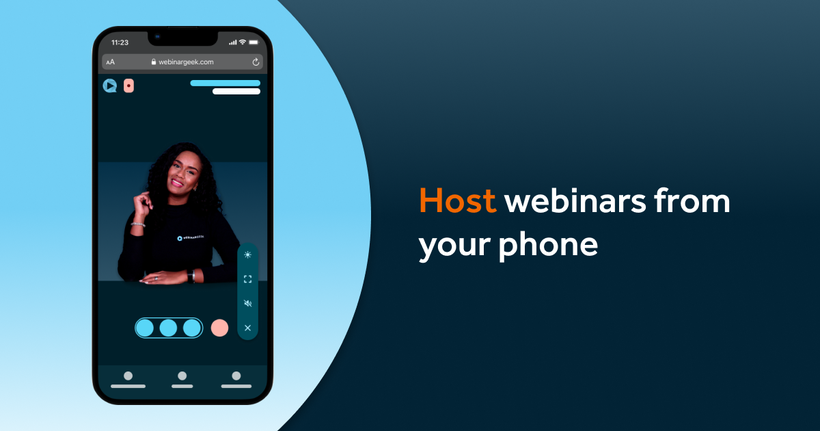
Broadcast a webinar from your mobile phone
Gone are the days when you needed a fancy studio, high-end equipment, or even a desktop computer to host a webinar. Now, all you really need is your mobile phone! Yes, that little device in your pocket can do way more than just send texts or scroll through memes.